


Lattice overview: capabilities, features, use cases, and value by role
Lattice® is an HR platform that brings together people management and AI tools to support employee growth, manager effectiveness, and company performance.
Top capabilities of Lattice
Performance
Read detailsLattice Performance spans performance management mechanisms across the employee lifecycle — connecting performance, development, engagement, and planning in one place. One customer put it directly: "Lattice gives us a central hub where performance, development, engagement, and planning come together. It lets us operate strategically and speak the same language as our Finance partners." That same team found the product foundational to how the business runs, noting "It's not just a tool – it's foundational to how we operate. And it's one of the reasons we've been able to grow so efficiently while keeping people and performance at the center." Outcomes reported by customers include a 91% engagement rate and 98% performance review completion, and performance review completion rates increasing with each review cycle after implementing Lattice.
Feedback
Read detailsLattice Feedback brings continuous, real-time feedback into daily work through peer tools, external feedback requests, AI-generated insights for more objective performance reviews, and integrations with Slack, Microsoft Teams, and email — with customers reporting measurable gains in participation, such as a jump from 34% to 54% after additional training and 82% of employees participating in a single campaign. One customer describes the approach as "Feedback is something we try and embed into our day-to-day at 9fin, as opposed to an exercise that happens once or twice a year." Another found that "Feedback was the right place to begin — it was simple, relatable, and helped us build trust."
Engagement
Read detailsLattice Engagement gives organizations a way to collect employee feedback, surface AI-powered insights, and run programs aimed at improving productivity and retention. The results customers describe are concrete. One customer hit a 97% response rate and 78% participation on engagement surveys. Another saw a 35% boost in employee engagement after launching the FLY framework in Lattice. The day-to-day value shows up in how HR teams talk about it. At Guinness World Records, one HR leader put it plainly: "Lattice is an integral part of our annual engagement calendar. And it gives me back my weekend." The contrast with older tools is just as telling. As one Fandom team member noted: "We were only using our previous platform for annual reviews and engagement surveys. Some of our employees admitted that they only logged in once a year because they had to."
Goals & OKRs
Read detailsLattice Goals & OKRs lets organizations set, track, and align goals across employees and teams through an integrated system — as one customer put it, "Whilst implementing company-wide OKRs can be challenging, Lattice has made this easy by creating an integrated system for managing goals, making it easier to align efforts and track progress across the organisation." The same customer noted that "Lattice gave us the framework to introduce OKRs, along with excellent enablement materials to guide us." Adoption results back this up: 100% of employees have at least one goal published, with nearly 800 active goals across the company at one organization, and over 80% of the business has used Lattice to set goals at another.
Grow
Read detailsLattice Grow connects employee career development and learning pathways directly inside the Lattice platform. In one customer's words, "We retain people because, thanks to Lattice Grow, their goals and aspirations become ours." Another customer puts it this way: "People don't have to leave Property Finder to grow anymore. They just need clarity, support, and the tools to see what's possible – and Lattice gives us all three." At Property Finder, 80% of eligible employees have an active IDP via 42 Success Tracks in Lattice Grow. At Valimail, Grow engagement increased to 30% without any formal incentive.
Habits
Read detailsLattice Habits is a single shared system that connects 1:1s, weekly updates, feedback and praise, and Q&A boards to performance outcomes through Goals and AI Agent. When teams use the structure consistently, the numbers reflect it: 76% of employees set up a 1:1 in Lattice, with 3,816 1:1s held over the same period. At another organization, nearly 60% of managers hold 1:1s with direct reports, averaging 438 1:1s per month. The pattern has a practical payoff. In one customer's words: "I've noticed that teams who use one-on-ones frequently have fewer complaints, fewer communication issues, and faster reviews within said team." The AI Agent carries that continuity into performance reviews. As one customer describes it: "Reviews used to feel heavy. With Lattice's AI Agent embedded into reviews, people actually have a starting point — and it saves teams time in writing thoughtful reviews that connect back to their goals, feedback, 1:1s and more."
Performance Reviews
Read detailsLattice Performance Reviews runs structured, customizable review cycles — annual, quarterly, project-based, and automated — through tools including AI-powered peer feedback summaries, goals and OKR integration, calibration workflows, and real-time analytics. One customer notes that "Having everything centralised—OKRs, one-to-ones, and performance reviews—has been incredibly valuable." Teams using the platform have seen a 93% completion rate in their latest performance review cycle, and one people team reports saving 10-15 hours per week managing the process. As one customer put it, "With Lattice, our performance reviews are no longer just 'ticking the box.' They've become pivotal, important, and meaningful conversations that help employees figure out their careers in the organization and beyond."
Compensation
Read detailsLattice Compensation handles the full compensation management workflow in one place, from strategy design through execution. Users report that the anxiety around compensation cycles disappears once they're running on it — in one customer's words, "I no longer dread compensation cycles—this is a big win!" Lattice Compensation also reaches beyond HR into the finance function. As one customer describes it, Lattice Compensation makes CFO "very happy" enabling better budgeting and data-based projections. Manager adoption can follow suit as well, with 100% recommendations submitted in the last review cycle at Loop.
Updates
Read detailsLattice Updates helps employees share regular status updates through customizable prompts and real-time progress tracking, while giving managers sentiment analysis, obstacle visibility, and connections to goals and performance data. One customer notes: the 1-on-1s and Weekly Updates have been a great way for me to understand what each person on my team is doing and, more importantly, how I can support and guide them by removing barriers and providing direction. Adoption tends to follow leadership engagement — as one customer put it, "once our CEO began integrating them into his one-to-ones with direct reports and actively engaging with goal updates, it was transformational for our organisation." That same team went from low participation to 98% in goal updates once our CEO got involved.
AI Overview
Read detailsLattice AI draws on six named tools — an AI Agent, Performance Insights, Engagement Insights, Writing Assistance, Recommended Growth Plans, and Team Health, all powered by OpenAI — to elevate human decision-making for managers and HR teams while maintaining GDPR and SOC 2 compliance. One customer's words capture early adoption: "People started using the Lattice AI Agent for coaching. Asking questions like, 'How do I write a performance review?', 'How do I handle this situation?'" The AI Agent has been shown to resolve up to 78% of HR questions instantly. Writing Assistance accelerated review cycles at one organization, where managers wrote their reviews 2x faster and ICs wrote their reviews 3x faster. Engagement Insights scaled qualitative analysis for another team, with around 30 hours saved per survey when processing thousands of engagement survey comments.
Analytics
Read detailsLattice Analytics connects performance, productivity, and engagement data into a unified view of your workforce. In one customer's words, "Lattice interweaves all the analytics together in an easy-to-understand way to create deeper insights."
AI Agent
Read detailsLattice AI Agent is an always-on HR partner built directly into the Lattice platform. It delivers instant answers, actionable insights, and personalized coaching for HR and people management tasks. One customer notes that reviews used to feel heavy, but with Lattice AI Agent embedded, people actually have a starting point.
Talent Reviews
Read detailsLattice Talent Reviews supports data-driven employee evaluations through customizable review templates, nine-box grids, calibration workflows, and integration with performance and engagement data — all working together to surface high-potential employees and inform succession planning.
Succession Planning
Read detailsLattice Succession Planning is built for organizations that need to create, collaborate on, and manage succession plans — keeping their talent bench strong and their workforce continuity intact over the long term.
PIPs
Read detailsLattice PIPs equips HR leaders and managers to create, track, and manage performance improvement plans directly within the platform. Built-in templates, HR-approved workflows, audit trails, progress tracking, and analytics power the feature. Together, these tools transform PIPs from reactive paperwork into a structured, defensible, and proactive growth strategy.
Top features of Lattice
Top use cases for Lattice
Run structured performance review cycles
Read detailsHR teams and managers use Lattice to design, launch, and streamline performance review cycles across annual, quarterly, project-based, or automated cadences. The platform brings together AI-powered peer feedback summaries, Goals & OKR integration, calibration workflows, and people analytics dashboards to produce holistic, data-driven evaluations.
Turn workforce data into strategic people decisions
Read detailsLattice's People & HR Analytics brings performance, engagement, and talent data together in one place, so HR leaders and managers aren't switching between separate tools to get a complete picture. The platform offers heatmaps, DEIB analytics, and Team Analytics. Reporting is customizable, which means teams can surface the specific trends that matter to their workforce questions. The underlying goal is to support decisions around retention, equity, and organizational effectiveness.
Scale manager effectiveness with AI-powered coaching
Read detailsLattice AI's suite covers the AI Agent for instant policy and career answers, Manager Effectiveness insights that flag burnout risks, AI-powered performance review writing assistance, recommended growth plans, and Team Health trend analysis — giving HR teams and managers tools to coach employees consistently at scale, save time on administrative tasks, and make informed talent decisions without adding headcount.
Identify and develop high-potential talent
Read detailsLattice Talent Reviews consolidates performance and potential evaluations into one place for HR teams, managers, and executives. The feature uses 9-box grids and calibration workflows alongside integrated performance and engagement data. Together, those tools help teams identify high-potential employees and surface talent gaps. Teams also use Lattice Talent Reviews to inform succession planning and get ahead of attrition risks before they become problems.
Build and maintain leadership succession pipelines
Read detailsLattice Succession Planning gives teams one place to track successor information, readiness, and attrition risk. Those plans connect directly to calibration and performance workflows. That connection moves planning from reactive replacement toward deliberate talent development, reducing single-points-of-failure risk over time.
Keep managers and employees aligned through regular check-ins
Read detailsLattice's one-on-one meeting tools connect managers and direct reports around a shared workflow for agendas, action items, and coaching. Managers and employees can customize meeting cadence to fit their rhythm. Action items are tracked through to resolution rather than lost between conversations. Recognition and feedback reach people where they already work, through integrations with Slack, Teams, and email. That same workflow supports employee development, career growth, and retention.
Measure and improve employee engagement
Read detailsLattice's engagement suite turns employee feedback into structured action plans for improving retention, engagement, and workforce performance. HR professionals and managers can collect that feedback through pulse surveys, eNPS, onboarding surveys, and exit surveys. AI-powered key driver analysis and sentiment tracking then surface actionable insights from the data. From there, teams can build targeted action plans based on what those insights reveal.
Align teams around goals and business priorities
Read detailsLattice's Goals and OKRs tools connect objective-setting across every level of an organization, from leadership down to individual contributors. Managers, employees, and leaders can set, cascade, and track objectives in one place. The tools integrate with Slack, Teams, and JIRA for real-time visibility. They also connect directly to 1:1s and performance reviews, so every team member's effort is transparently tied to business outcomes and company priorities.
Manage and resolve employee underperformance
Read detailsLattice Performance Improvement Plans replace reactive paperwork with a standardized, data-informed process for managing underperformance. HR leaders and managers work from approved templates and HR-sanctioned workflows, so the process stays consistent across the organization. Progress is tracked alongside reviews and 1:1s. PIP trends can also be analyzed across teams, giving leaders a clearer picture of where underperformance clusters. The structured approach reduces compliance risk throughout.
Develop employees with clear career growth paths
Read detailsLattice Grow connects individual development planning directly to defined career tracks and competency frameworks. Employees and managers build Individual Development Plans together, grounding them in those structures rather than leaving them as standalone documents. Growth conversations happen inside regular 1:1s rather than as separate, easy-to-skip events. Lattice Grow also surfaces personalized development opportunities through AI-powered Growth Areas from the Lattice AI Agent.
Run fair and data-driven compensation cycles
Read detailsLattice lets HR, Compensation, and Finance leaders run org-wide compensation cycles by combining Mercer-powered salary benchmarking, compensation band visualization, pay-for-performance review integration, pay equity analytics, and personalized statement shareouts into a single workflow for structured, defensible pay decisions.
Establish consistent team rhythms that drive performance
Read detailsLattice Habits structures the recurring work of management into a steady cadence of 1:1s, weekly updates, feedback exchanges, and Q&A boards. It integrates with Goals and the Lattice AI Agent to surface summaries and suggest follow-ups. Together, these routines help managers, employees, and leaders reduce misalignment, lost context, and dropped action items while keeping teams aligned on what matters most.
Value delivered by role with Lattice
Individual Contributors
Read detailsLattice gives individual contributors visibility into performance expectations, career growth pathways, and how their goals connect to team and company objectives. Individual Development Plans, growth tracks, continuous feedback, and 1:1s work together so employees can identify development areas, request feedback from peers and managers on demand, and track progress toward both short- and long-term goals. Customers report higher satisfaction with career development conversations, greater clarity around promotion criteria, and stronger confidence in their growth trajectory. The operational reality can be significant. One team noted that when we looked at review cycles and completion data, we saw managers and employees spending around 2,000 hours over two months on this process, and 60% of employees now have an Individual Development Plan embedding growth into daily work. Reaching a distributed workforce adds another layer of complexity. As one customer puts it, We had to invest in infrastructure, build new processes, and think creatively about how to reach our people. For example, implement reverse billing so employees could use their mobile phones to access the Lattice app.
HR Leaders
Read detailsLattice brings performance, development, engagement, and planning into a single hub, letting HR leaders move from reactive administration to data-driven people strategy. The efficiency gains are concrete. One customer described the old process in their own words: "I was screenshotting into Paint, cropping, then back into PowerPoint — easily an extra day's work. Now I can enjoy my weekend." Time recovered from manual work adds up quickly across teams. One people team reports saving 10-15 hours per week managing the process. Another saw 80% of People team work now focused on driving business forward rather than reactive tasks. Talent metrics shift too, with one team reporting a 95% increase in eNPS scores. As one customer puts it, "Lattice has the potential to be game-changing for Mind Foundry. It makes our people team more efficient and valuable, in terms of the success of the business."
People Managers
Read detailsLattice puts everything a people manager needs to lead their team into a single place. Real-time dashboards, performance summaries, and AI-powered insights sit alongside structured tools for 1:1s, feedback, goal-setting, and career development. Feedback history, growth plans, goal progress, and compensation data are all visible in one view. As one customer puts it, "I love that Lattice makes it so our people leaders don't have to hunt for information about their teams." The result is a shift from reactive administration to proactive team leadership. Case evidence points to outcomes including 100% on-time review completion and 2x faster review writing.
Chief Executive Officers
Read detailsLattice connects CEO visibility to organizational performance by surfacing goal progress, employee sentiment, and engagement data in one place. When CEOs engage directly, the effect on participation can be dramatic — one company saw goal update participation boosted from 50% to 98% in a single year after CEO involvement. That kind of data credibility is exactly what one customer described: "I can show my CEO we have a 90% completion rate, when 5,000 other customers are at 82%, so the data speaks for itself."
What customers say about Lattice: ratings, outcomes and feedback
Lattice® customers report on two aspects of their day-to-day experience: what they find valuable in regular use and where they see room for improvement. These two dimensions cover how customers engage with Lattice in practice.
What works well
Customers describe Lattice as a platform that holds up across the full range of people-management needs, not just individual pieces. One customer at Mind Foundry put it directly: "All the other providers we looked at— including Bamboo, Culture Amp, and 15five —were good at individual parts. But only Lattice was holistically good across everything". Scaling teams point to that breadth as what makes the platform durable. As one iVision leader said: "It's the kind of foundation we need to go from a 300-person to a 900-person company, and beyond." The working relationship with Lattice also comes up. A Coca-Cola Peninsula Beverages contact noted that every call gave energy and new ideas, and that it never felt like "CPPB vs 1,300 people — it felt like we were in it together." Teams at Npact point out that leadership buy-in was essential to their success with the platform.
Where customers see room for improvement
Lattice draws consistent improvement requests in four areas: meeting history access, template flexibility, pricing for smaller teams, and privacy granularity. The most repeated friction point is past one-on-one notes. As customers put it, there's no ability to search through old 1:1 meeting notes aside from manually going through each one. Customers want a quick summary view of past discussions without toggling through each meeting individually. Template customization is the next common ask. Direct reports currently copy and paste from manager templates to fill in specific information. Customers want fillable templates or form-style inputs built directly into the product. Pricing surfaces as a concern for smaller organizations, who feel the cost runs high relative to their needs. On the privacy side, customers want more granular subgroup controls within a main group. These requests come alongside broadly positive sentiment. Lattice busts the stereotype that HR is clunky and process-driven, and teams report fewer complaints, fewer communication issues, and faster review cycles.
Lattice Customer wins, Case studies
Frequently Asked Questions (FAQ)
What buyers ask before choosing Lattice
Integrations What CRM integrations are available for Lattice?
Lattice offers robust integrations with several CRM platforms, most notably Salesforce, which specializes in customer relationship management solutions. This integration allows employees to connect their Lattice goals directly to Salesforce reports, enabling seamless tracking and alignment of performance metrics with customer interactions. By leveraging this integration, businesses can automate workflows and gain valuable insights into their operations, enhancing overall efficiency. Additionally, Lattice's ecosystem supports various other integrations that empower teams to utilize their preferred HR tools effectively. This interconnected approach ensures that Lattice can fit seamlessly into your existing tech stack, making it easier for organizations to manage employee performance and engagement alongside their customer relationship efforts.
Integrations What CRM integrations does Lattice offer?
Lattice offers robust integrations with several leading CRM platforms, most notably Salesforce, which specializes in customer relationship management solutions. This integration allows employees to seamlessly connect their Lattice goals to Salesforce reports, enabling automatic updates and streamlined workflows. By linking performance management with CRM data, organizations can gain valuable insights into employee performance in relation to customer interactions and sales outcomes. This capability enhances the alignment between people strategies and business objectives, making it easier for teams to track progress and drive results. Additionally, Lattice's commitment to providing a comprehensive suite of integrations ensures that businesses can connect with their favorite tools, facilitating a more efficient and cohesive operational environment.
Integrations How does Lattice connect to Salesforce for data synchronization?
Lattice connects to Salesforce for data synchronization through its dedicated Salesforce integration, which allows organizations to link their Lattice goals directly to Salesforce reports. This integration ensures that performance metrics and employee objectives are automatically updated and reflected in Salesforce, providing a seamless flow of information between the two platforms. By synchronizing data, businesses can gain valuable insights into employee performance in relation to customer interactions and sales outcomes, enhancing decision-making processes. This connection not only streamlines workflows but also helps teams align their goals with broader business objectives, ultimately driving productivity and engagement across the organization.
Integrations How does Lattice connect with Salesforce for data synchronization?
Lattice connects with Salesforce for data synchronization through its dedicated integration, allowing seamless alignment between employee goals in Lattice and Salesforce reports. This integration enables organizations to automatically sync performance metrics and objectives, ensuring that all stakeholders have access to real-time data. By linking Lattice's goal-setting features with Salesforce's robust customer relationship management tools, businesses can enhance their workflow efficiency and gain deeper insights into employee performance in relation to customer interactions. This connection not only streamlines processes but also empowers teams to make data-driven decisions, ultimately driving better outcomes for both employee engagement and customer satisfaction.
Integrations What are the setup steps for integrating Lattice with HubSpot?
To integrate Lattice with HubSpot, start by ensuring you have administrative access to both platforms. First, log into your Lattice account and navigate to the integrations section. Look for HubSpot in the list of available integrations and select it. You will then be prompted to authenticate your HubSpot account by logging in and granting necessary permissions for Lattice to access your HubSpot data. Once authenticated, configure the integration settings according to your preferences, such as selecting which data to sync between the two platforms. Finally, test the integration to ensure that data flows smoothly from HubSpot to Lattice, allowing you to leverage insights from both systems effectively. For detailed guidance, refer to Lattice's support documentation or reach out to their customer support team for assistance.
Integrations Can Lattice integrate with Marketo, and if so, how does the data flow work?
Yes, Lattice can integrate with Marketo, allowing for a seamless flow of data between the two platforms. This integration enables organizations to synchronize employee performance and engagement data with their marketing automation efforts in Marketo. The data flow typically involves exporting employee feedback, performance metrics, and engagement scores from Lattice into Marketo, where it can be utilized for targeted marketing campaigns or internal communications. This connection helps ensure that HR and marketing teams are aligned, leveraging insights from employee data to enhance overall organizational strategies. By integrating Lattice with Marketo, companies can create a more cohesive approach to managing both employee and customer experiences, ultimately driving better business outcomes.
Integrations What API access does Lattice provide for third-party integrations?
Lattice provides robust API access that enables seamless third-party integrations, allowing businesses to connect their existing tools and systems with Lattice's platform. This API access facilitates the transfer of data between Lattice and other applications, enhancing workflows and ensuring that employee feedback, performance metrics, and recognition are synchronized across platforms. Companies can leverage this capability to integrate with popular tools such as Slack, Microsoft Teams, and various HR systems, streamlining communication and feedback processes. By utilizing Lattice's API, organizations can customize their experience, automate data flows, and enhance their people strategies, ultimately driving better employee engagement and performance outcomes. For specific API documentation and integration guidelines, users can refer to Lattice's developer resources.
Integrations What API access does Lattice provide for custom integrations?
Lattice provides robust API access that enables organizations to create custom integrations tailored to their specific needs. This API allows developers to interact with various Lattice functionalities, such as employee data, performance reviews, and feedback mechanisms, facilitating seamless data exchange between Lattice and other systems. By leveraging this API, businesses can automate workflows, synchronize employee information, and enhance reporting capabilities, ultimately improving operational efficiency. Additionally, Lattice's API documentation offers detailed guidance on how to implement these integrations, ensuring that teams can effectively utilize the platform's capabilities alongside their existing tools. This flexibility is particularly valuable for companies looking to create a cohesive tech stack that aligns with their unique people management strategies.
Integrations Are there any limitations to the data sync behavior between Lattice and other systems?
While Lattice offers robust integrations with various tools to streamline workflows, there are some limitations to the data sync behavior between Lattice and other systems. For instance, the frequency of data updates may vary depending on the specific integration, which can affect real-time data availability. Additionally, certain data fields may not sync automatically, requiring manual updates or adjustments in some cases. It's also important to note that while Lattice integrates with popular platforms like Slack and Teams, the depth of integration can differ, potentially limiting the extent of data shared between systems. Understanding these limitations is crucial for organizations to effectively plan their data management strategies and ensure seamless operations across their tech stack.
Integrations Are there any limitations to the data sync between Lattice and other systems?
While Lattice offers numerous integrations with popular tools like Slack and Microsoft Teams, there may be some limitations regarding data sync between Lattice and other systems. These limitations can include the frequency of data updates, the types of data that can be synchronized, and potential discrepancies in data formats. For instance, certain integrations may only allow for one-way data transfer, meaning updates made in Lattice may not reflect back in the integrated system. Additionally, organizations should consider the need for custom configurations or middleware to facilitate more complex data sync requirements. It's essential to review the specific integration documentation and consult with Lattice support to understand the capabilities and limitations of each integration to ensure seamless workflows.
Features What does the customizable reporting feature in Lattice do?
The customizable reporting feature in Lattice's analytics platform allows organizations to create tailored reports that align with their specific metrics and needs. This flexibility enables stakeholders to access relevant and actionable data, ensuring that the insights generated are directly applicable to their business objectives. Users can select various data points, visualize trends, and analyze performance indicators that matter most to their teams. By leveraging this feature, organizations can enhance decision-making processes, track progress over time, and identify areas for improvement, ultimately driving better outcomes. The ability to customize reports not only saves time but also empowers teams to focus on the metrics that truly impact their success.
Features How do I create a customized report using Lattice's analytics platform?
To create a customized report using Lattice's analytics platform, start by logging into your Lattice account and navigating to the reporting section. From there, select the type of report you wish to generate, such as performance metrics or employee engagement data. Utilize the platform's customizable features to choose specific metrics, time frames, and data visualizations that align with your organization's needs. You can also filter the data to focus on particular teams or departments. Once you have configured your report, preview it to ensure it meets your requirements, and then save or export the report in your desired format. This flexibility allows stakeholders to access relevant and actionable insights tailored to their specific objectives, enhancing data-driven decision-making within your organization.
Features How do I create a customized report in Lattice's analytics platform?
To create a customized report in Lattice's analytics platform, start by logging into your Lattice account and navigating to the reporting section. From there, select the type of report you wish to create, such as performance metrics or employee engagement data. Utilize the platform's filtering options to choose specific metrics, date ranges, and employee groups that are relevant to your needs. You can also add visual elements like charts or graphs to enhance the report's clarity. Once you've tailored the report to your specifications, save it for future access or share it with stakeholders directly through the platform. This customizable reporting feature ensures that you can generate actionable insights that align with your organization's goals.
Features What functionality does the Adoption Dashboard provide in Lattice?
The Adoption Dashboard in Lattice provides a comprehensive overview of team engagement and performance metrics, allowing organizations to quantify the success of their people management strategies. This functionality surfaces key analytics, updates, and goals in one centralized location, enabling managers to easily monitor their teams' progress and identify areas that may require additional support. By visualizing data related to employee engagement and goal attainment, the Adoption Dashboard helps leaders make informed decisions and fosters a culture of accountability and transparency. This feature ultimately enhances manager effectiveness by streamlining communication and ensuring that teams remain aligned with organizational objectives, making it a valuable tool for driving performance and engagement within the workplace.
Features What information can I view on the Lattice dashboard?
The Lattice dashboard provides a comprehensive view of key metrics and analytics that are essential for effective team management. Users can access team analytics, updates, and goals all in one place, allowing managers to monitor their teams' progress and identify areas needing attention. Additionally, the dashboard features customizable reporting options, enabling organizations to tailor the displayed information to their specific needs and metrics. This flexibility ensures that stakeholders have access to relevant and actionable data, enhancing decision-making processes. Overall, the Lattice dashboard is designed to streamline communication and improve manager effectiveness by consolidating vital information in an easy-to-navigate interface.
Features How does Lattice AI enhance performance evaluations?
Lattice AI enhances performance evaluations by integrating directly into the performance management workflow, allowing managers and HR teams to leverage AI assistance where it is most needed. It streamlines the process by summarizing performance reviews, which reduces the time spent synthesizing feedback and enables managers to focus on actionable insights. Additionally, Lattice AI generates first drafts of review packets and suggests talking points for one-on-ones based on recent employee activity, ensuring that evaluations are informed and relevant. By identifying trends and providing key insights, Lattice AI helps reduce bias in evaluations, making them more accurate and fair. This results in a more efficient performance review process that aligns individual and team goals, ultimately driving better business outcomes.
Features How do I use the Adoption Dashboard in Lattice?
To use the Adoption Dashboard in Lattice, start by logging into your Lattice account and navigating to the dashboard section. The Adoption Dashboard provides a comprehensive view of how employees are engaging with various features and tools within the platform. You can customize the dashboard to focus on specific metrics that matter to your organization, such as participation rates in surveys or usage of performance management tools. Utilize the filters to segment data by teams or time periods, allowing you to identify trends and areas for improvement. Regularly review the insights generated to inform your strategies for enhancing employee engagement and adoption of Lattice's features, ensuring that your organization maximizes the value of the platform.
Features What features are included in Lattice's team analytics dashboard?
Lattice's team analytics dashboard includes a variety of features designed to enhance manager effectiveness and improve team performance. It surfaces key metrics such as team updates, goals, and progress in one centralized view, allowing managers to easily monitor how their teams are performing and identify areas that may require additional support. The dashboard also integrates employee feedback and engagement data, enabling managers to gain insights into employee sentiment and overall team dynamics. Additionally, it facilitates enhanced communication through tools like 1:1 meeting prompts and weekly updates, which help in flagging obstacles and fostering a culture of continuous feedback. This comprehensive approach ensures that managers have the necessary tools to drive engagement and productivity within their teams.
Features What features enhance communication during 1:1s in Lattice?
Lattice enhances communication during one-on-one meetings through a variety of intuitive features designed to foster collaboration and engagement. The platform allows users to set agendas, track action items, and maintain a history of past meetings, ensuring that discussions are organized and productive. Additionally, Lattice integrates seamlessly with communication tools like Slack and Microsoft Teams, enabling users to share feedback and recognition in real-time, which keeps the conversation flowing even outside of scheduled meetings. The visually appealing interface makes it easy to navigate and encourages participation, while features like due dates and checklists help keep both managers and employees accountable. Overall, these features create a structured yet flexible environment that promotes meaningful dialogue and strengthens relationships within teams.
Features How do I use Lattice to track team goals and progress?
To use Lattice for tracking team goals and progress, start by setting up customizable goal cycles that align with your team's objectives. Create specific, measurable goals for each team member and ensure they are linked to broader company goals for alignment. Utilize Lattice's visual progress tracking features to monitor advancements in real-time, allowing team members to see how their contributions impact overall success. Regularly check in on goal status and encourage team members to update their progress, fostering accountability and transparency. Additionally, leverage Lattice's integrations with other tools to streamline workflows and enhance collaboration. By consistently engaging with the platform, you can maintain focus on key priorities and drive continuous improvement within your team.
Features How do I flag obstacles through weekly updates in Lattice?
To flag obstacles through weekly updates in Lattice, start by accessing the employee updates feature within the Lattice People Management Platform. When prompted to provide your status update, clearly articulate the specific challenges or roadblocks you are facing in your current tasks. Use the designated section for obstacles to ensure your team and managers can easily identify these issues. Be concise but detailed enough to give context, which will help your team understand the situation better. Once submitted, your update will be visible to your team, allowing for proactive discussions and support to overcome these challenges. Regularly flagging obstacles not only keeps everyone informed but also fosters a collaborative environment where solutions can be developed collectively.
ROI & pricing What measurable benefits can Lattice provide for my organization?
Lattice offers measurable benefits that can significantly enhance your organization's employee experience and overall performance. According to a study commissioned by Forrester Consulting, Lattice can drive up to $3.5 million in benefits by improving employee engagement, retention, and productivity. The platform's capabilities in performance management, goal setting, and survey analytics allow organizations to gain valuable insights into employee sentiment and identify key areas for improvement. By leveraging Lattice's AI-driven analytics, companies can quickly synthesize survey results and open-ended feedback, enabling data-driven decision-making. This not only fosters a culture of continuous improvement but also aligns individual and organizational goals, ultimately leading to a more engaged and high-performing workforce.
ROI & pricing How does Lattice impact employee engagement and turnover rates?
Lattice significantly impacts employee engagement and turnover rates by providing tools that facilitate real-time feedback through engagement and pulse surveys. This platform helps organizations gather meaningful insights about employee sentiment and team health, enabling HR teams and managers to address concerns proactively. For instance, companies using Lattice have reported improvements in engagement scores and a reduction in turnover rates, as seen in a case where a firm reduced its turnover from 30-40% to a more manageable level by enhancing the adoption of OKRs and increasing participation in one-on-one check-ins. By fostering a culture of continuous feedback and support, Lattice empowers organizations to strengthen connections among employees, ultimately leading to higher engagement and lower turnover.
ROI & pricing How does Lattice impact ROI and cost savings for businesses?
Lattice significantly impacts ROI and cost savings for businesses by streamlining employee performance management and enhancing the overall employee experience. According to a study by Forrester, companies using Lattice can expect an average ROI of 195% with a payback period of just three months. This is achieved through improved efficiency in performance reviews, which reduces the time managers spend on evaluations, ultimately saving costs associated with lost productivity. Lattice's tools facilitate structured feedback and evaluations, allowing organizations to identify top performers and ensure operational excellence. Additionally, the platform's flexible pricing model allows businesses to scale their usage according to their needs, further optimizing their investment in employee management solutions.
ROI & pricing What is the average ROI for companies using Lattice software?
The average ROI for companies using Lattice software is notably high, with a study conducted by Forrester revealing a remarkable 195% ROI and a payback period of just three months. This impressive return is attributed to various factors, including enhanced employee engagement, reduced turnover, and significant time savings during performance review cycles. By leveraging Lattice's comprehensive suite of tools, organizations can streamline their performance management processes, leading to improved productivity and operational efficiency. Additionally, Lattice's interactive ROI estimator allows potential users to calculate their specific ROI based on their unique circumstances, further demonstrating the software's value in driving financial benefits for businesses.
ROI & pricing What are the different pricing plans available for Lattice?
Lattice offers flexible pricing plans designed to accommodate the varying needs of organizations. The foundational plan starts at $11 per seat per month, with additional options available for 4 and 6 seat plans, allowing businesses to scale as they grow. Pricing for enterprise solutions is customized based on the number of seats, complexity, and scale of the organization, and interested parties can contact Lattice for a tailored quote. This structure enables companies to select the products they need today while retaining the flexibility to add more features later, ensuring that Lattice can grow alongside their business.
ROI & pricing How can I estimate the total cost of ownership for using Lattice?
To estimate the total cost of ownership (TCO) for using Lattice, you can utilize the Lattice ROI Estimator, which is an interactive tool designed to help organizations assess the financial implications of implementing Lattice's software. This estimator takes into account various factors such as the number of seats required, the specific products you plan to use (like Performance or Goals & OKRs), and any additional fees for implementation or change management. Additionally, consider the ongoing costs associated with customer support and any potential upgrades as your organization grows. By analyzing these components, you can gain a clearer picture of the overall investment needed for Lattice, ensuring it aligns with your budget and HR goals.
ROI & pricing How quickly can I expect to see a return on investment after implementing Lattice?
After implementing Lattice, you can expect to see a return on investment (ROI) relatively quickly, with a reported payback period of just three months according to a study conducted by Forrester. The study highlights that companies utilizing Lattice can achieve an average ROI of 195%, translating into significant financial benefits, estimated at $3.5 million across various aspects of employee experience and people strategy. This rapid ROI is largely attributed to Lattice's ability to enhance performance management, streamline employee reviews, and improve engagement, ultimately leading to increased productivity and reduced turnover. By leveraging Lattice's comprehensive suite of tools and dedicated support, organizations can effectively realize these benefits in a short timeframe, making it a valuable investment for businesses looking to optimize their HR processes.
ROI & pricing What is the expected time-to-value when implementing Lattice in my company?
The expected time-to-value when implementing Lattice in your company can vary based on several factors, including the size of your organization and the specific features you choose to utilize. Generally, companies can start seeing benefits within a few weeks of implementation, particularly if they engage with Lattice's dedicated onboarding support. This support includes a personalized onboarding manager who helps streamline the setup process and ensures that your team is effectively trained on the platform. As Lattice is designed to be scalable and customizable, organizations can gradually adopt more features, allowing for continuous improvement in employee performance and engagement over time. Ultimately, many users report significant enhancements in employee sentiment and productivity shortly after deployment, making Lattice a valuable investment for your people strategy.
ROI & pricing How can Lattice help improve employee engagement and reduce turnover?
Lattice improves employee engagement and reduces turnover by providing technology companies with tools to gather and analyze real-time feedback through engagement surveys and pulse checks. This platform delivers actionable insights into employee sentiment, team health, and overall workplace experience, enabling HR teams and managers to identify areas for improvement and take proactive measures. By fostering open communication and continuous feedback, Lattice helps create a supportive environment that encourages employee growth and strengthens connections among team members. Additionally, the thoughtful onboarding experience ensures new hires feel welcomed and aligned with company expectations, further enhancing engagement. Ultimately, Lattice's data-driven approach empowers organizations to build a more inclusive culture, which is crucial for retaining top talent and minimizing turnover.
Capabilities What features does Lattice offer for performance management?
Lattice offers a comprehensive suite of features for performance management that enhances the evaluation process and fosters employee development. Key features include customizable templates for performance reviews, automated workflows that streamline the review process, and personalized permissions that allow organizations to tailor access based on roles. Additionally, Lattice provides real-time analytics, enabling HR teams to gain insights into employee performance and identify top performers. The platform also supports continuous feedback mechanisms, flexible review cycles, and data-driven goal management, which are particularly beneficial for aligning teams with organizational objectives. These features collectively empower organizations to conduct efficient performance evaluations while promoting a culture of continuous improvement and open communication.
Capabilities Can Lattice provide customizable reporting features?
Yes, Lattice's analytics platform offers robust customizable reporting features that allow organizations to create reports tailored to their specific needs and metrics. This flexibility is essential for stakeholders, as it ensures they have access to relevant and actionable data that can drive informed decision-making. Users can select the metrics that matter most to them, enabling a more focused analysis of performance and employee engagement. By leveraging these customizable reporting capabilities, organizations can better align their strategies with their goals, ultimately enhancing their operational efficiency and effectiveness. This adaptability makes Lattice an invaluable tool for businesses looking to harness data for continuous improvement.
Capabilities Can Lattice provide customizable reporting for my organization?
Yes, Lattice can provide customizable reporting for your organization through its analytics platform. This feature allows you to generate reports tailored to your specific needs and metrics, ensuring that stakeholders have access to relevant and actionable data. The flexibility of Lattice's reporting capabilities means you can focus on the key performance indicators that matter most to your organization, facilitating data-driven decision-making. By customizing reports, you can better analyze employee performance, engagement, and other critical metrics, ultimately enhancing your strategic initiatives. This adaptability makes Lattice an ideal choice for organizations looking to leverage data effectively and align reporting with their unique objectives.
Capabilities Does Lattice support performance insights through AI?
Yes, Lattice supports performance insights through its AI-powered platform, which is designed to enhance various aspects of performance management. The Lattice AI Agent integrates seamlessly into the performance management workflow, enabling managers and HR teams to receive AI assistance directly where they need it. This includes summarizing performance reviews to save time, generating first drafts of review packets, and suggesting talking points for one-on-one meetings based on recent employee activity. Additionally, Lattice's AI synthesizes survey results and open-ended feedback, providing key driver analysis that helps organizations understand employee sentiment and identify areas for improvement. By leveraging these insights, businesses can make informed talent decisions and foster a more engaged workforce.
Capabilities Can Lattice help align individual and team goals across the organization?
Yes, Lattice can effectively help align individual and team goals across the organization through its goal management software. By enabling organizations to set, track, and align goals at various levels—individual, team, and company—Lattice fosters clarity and accountability. The software features customizable goal cycles and visual progress tracking, which ensure that everyone remains focused on key priorities. This alignment not only enhances transparency but also encourages collaboration among teams, as individuals can see how their goals contribute to broader organizational objectives. As a result, Lattice supports continuous progress and helps maintain a cohesive direction, ultimately driving organizational success.
Capabilities Does Lattice support real-time feedback and praise among employees?
Yes, Lattice supports real-time feedback and praise among employees, which is a core feature of its employee feedback software. The platform enables seamless sharing of feedback and recognition, allowing employees to provide and receive insights promptly. This immediacy fosters a culture of continuous improvement and open communication, as employees can acknowledge each other's achievements and offer constructive feedback in real time. By integrating with communication tools like Slack and Microsoft Teams, Lattice ensures that feedback is not only timely but also visible, enhancing engagement and motivation across teams. This approach helps organizations drive performance and growth by making feedback an integral part of the daily work experience.
Capabilities Is Lattice's performance management software scalable for large enterprises?
Yes, Lattice's performance management software is highly scalable and specifically designed to meet the needs of large enterprises. The platform's flexibility allows it to adapt to the complex structures and diverse requirements of larger organizations, ensuring that it can support a wide range of performance management processes. Lattice offers features such as continuous feedback, flexible review cycles, and data-driven goal management, which are essential for maintaining alignment across multiple teams and departments. Additionally, Lattice's interconnected product suite is built to evolve alongside your organization, helping to streamline performance management as your enterprise grows and changes. This scalability ensures that Lattice can effectively support your organization’s performance management needs both now and in the future.
Capabilities Does Lattice ensure data security with encryption and access controls?
Yes, Lattice ensures data security through robust measures that include data encryption and strict access controls. These security protocols are designed to protect sensitive compensation information, ensuring that only authorized personnel can access this data. By employing industry-standard encryption techniques, Lattice safeguards data both in transit and at rest, minimizing the risk of unauthorized access. Additionally, access controls are implemented to restrict data access based on user roles, further enhancing security. This comprehensive approach not only protects personal data but also aligns with best practices in data privacy and information security, providing peace of mind to organizations that rely on Lattice for their HR and compensation management needs. For more details on Lattice's security measures, you can visit their privacy page.
Capabilities How does Lattice ensure data security and compliance for sensitive information?
Lattice ensures data security and compliance for sensitive information through a comprehensive approach that includes robust security measures and adherence to industry standards. The company employs data encryption and strict access controls to protect sensitive compensation information, ensuring that only authorized personnel can access this data. Additionally, Lattice maintains a written information security program that complies with applicable laws and regulations, including the General Data Protection Regulation (GDPR) and the California Privacy Rights Act (CPRA). By proactively managing compliance risks and investing in privacy practices, Lattice aims to safeguard personal information collected from users, such as company email addresses and job titles. For more detailed information on Lattice's privacy and security practices, you can visit their privacy page at https://lattice.com/privacy/home.
Capabilities Can Lattice's performance management software scale for large enterprises?
Yes, Lattice's performance management software is designed to scale effectively for large enterprises. Its robust architecture allows for customization and flexibility, accommodating the complex needs of larger organizations. Lattice supports a wide range of features, including goal tracking, performance reviews, and continuous feedback mechanisms, which can be tailored to fit the specific requirements of large teams. Additionally, Lattice promotes a culture of ongoing development and engagement, essential for maintaining productivity in expansive workforces. The platform's ability to evolve alongside an organization ensures that it can meet both current and future demands, making it a suitable choice for enterprises looking to enhance their performance management processes.
Capabilities Does Lattice offer guidance for customizing the platform to fit specific organizational needs?
Yes, Lattice provides comprehensive guidance for customizing its platform to meet specific organizational needs. The platform includes resources and support to help organizations tailor features such as performance management, one-on-one meetings, and employee development plans according to their unique requirements and culture. This customization process is designed to ensure a smooth transition and effective utilization of the platform, allowing businesses to align Lattice's functionalities with their operational goals. Additionally, Lattice's flexibility enables organizations of all sizes, including startups and small businesses, to adapt the software as they grow, ensuring that it continues to meet their evolving needs.
Use cases How can SDRs use Lattice to improve their performance review process?
Sales Development Representatives (SDRs) can leverage Lattice to enhance their performance review process by utilizing its customizable templates and automated workflows, which streamline the evaluation of their performance metrics. By integrating real-time feedback and continuous coaching features, SDRs can receive timely insights into their strengths and areas for improvement, fostering a culture of open communication. Lattice's AI capabilities also assist in synthesizing feedback from various sources, enabling SDRs to prepare for reviews more effectively by reflecting on past performance and setting actionable goals. Additionally, the platform's analytics provide valuable data to track progress over time, ensuring that SDRs can align their efforts with organizational objectives and drive higher achievement in their roles.
Use cases How can SDRs use Lattice to improve their performance review processes?
Sales Development Representatives (SDRs) can leverage Lattice to enhance their performance review processes by utilizing its adaptable performance management features. Lattice allows SDRs to conduct performance reviews tailored to their specific needs, whether through annual reviews, quarterly development cycles, or project-based assessments. The platform also facilitates continuous feedback, enabling SDRs to receive real-time insights and praise from peers and managers, which fosters a culture of open communication and continuous improvement. Additionally, Lattice's AI capabilities can help SDRs synthesize feedback and analyze performance metrics efficiently, allowing them to identify strengths and areas for growth. By integrating these features, SDRs can streamline their review processes, ultimately driving higher achievement and engagement within their teams.
Use cases What are the best practices for marketers to implement OKRs using Lattice?
To effectively implement OKRs using Lattice, marketers should start by clearly defining their objectives, ensuring they align with broader company goals. It's essential to involve the entire marketing team in the goal-setting process to foster ownership and accountability. Regularly track progress using Lattice's intuitive tools, which provide visual dashboards and real-time insights, allowing teams to identify roadblocks early. Schedule consistent check-ins to discuss progress and adjust OKRs as needed, promoting a culture of transparency and collaboration. Additionally, leveraging Lattice's cascading alignment feature can help ensure that individual and team objectives are connected to overarching marketing strategies, enhancing focus and driving business results. By following these best practices, marketers can maximize the effectiveness of their OKRs within the Lattice platform.
Use cases What workflows can marketing teams implement with Lattice to enhance employee engagement?
Marketing teams can implement various workflows with Lattice to enhance employee engagement by utilizing its features for feedback, surveys, and performance reviews. For instance, they can design and distribute engagement surveys and pulse checks to gather real-time insights on employee sentiment and team health. This data can inform marketing strategies and internal communications, ensuring that messaging resonates with employees. Additionally, Lattice allows for structured check-ins and feedback loops, enabling marketing teams to recognize and celebrate employee contributions, which fosters a positive workplace culture. By leveraging Lattice’s sentiment analysis, marketing teams can identify trends and areas for improvement, tailoring their initiatives to better support employee engagement and satisfaction. Overall, these workflows help create a more connected and motivated workforce, ultimately benefiting the organization’s overall performance.
Use cases In what ways can RevOps teams leverage Lattice for real-time employee feedback?
RevOps teams can leverage Lattice for real-time employee feedback by utilizing its engagement and pulse survey features to gather insights on team performance and sentiment. By implementing Lattice's employee feedback software, RevOps teams can facilitate continuous feedback loops between employees and management, ensuring that insights are actionable and timely. This real-time feedback helps identify areas for improvement in processes and collaboration, ultimately driving operational efficiency. Additionally, Lattice's AI capabilities can synthesize feedback data quickly, providing RevOps teams with key driver analysis that highlights trends and potential issues. By integrating Lattice with existing tools and workflows, RevOps teams can create a culture of transparency and responsiveness, enhancing overall team dynamics and performance.
Use cases In what situations should RevOps teams utilize Lattice for workforce analytics?
RevOps teams should utilize Lattice for workforce analytics in situations where they need to align sales, marketing, and customer success efforts with employee performance and engagement metrics. Lattice provides comprehensive insights through engagement surveys and continuous feedback mechanisms, allowing RevOps teams to identify trends in employee sentiment and productivity that directly impact revenue generation. For instance, during periods of organizational change, such as mergers or new product launches, Lattice can help gauge employee morale and readiness, ensuring that teams remain engaged and productive. Additionally, when assessing the effectiveness of training programs or onboarding processes, Lattice's analytics can reveal how these initiatives influence employee performance and retention, enabling RevOps teams to make data-driven decisions that enhance overall business outcomes.
Use cases How can sales leaders utilize Lattice to enhance team engagement and morale?
Sales leaders can utilize Lattice to enhance team engagement and morale by leveraging its comprehensive suite of tools designed for real-time feedback and performance management. By implementing engagement surveys and pulse checks, sales leaders can gather valuable insights into team sentiment and identify areas for improvement. Lattice's analytics capabilities allow leaders to track engagement trends and understand the factors that contribute to team morale. Additionally, the platform facilitates ongoing communication and recognition, enabling sales leaders to celebrate achievements and provide constructive feedback. This proactive approach not only fosters a positive work environment but also drives motivation and productivity, ultimately leading to improved sales performance and team cohesion.
Use cases How can sales leaders leverage Lattice to align team goals and improve performance?
Sales leaders can leverage Lattice to align team goals and enhance performance through its robust features designed for continuous feedback and data-driven goal management. By utilizing Lattice's flexible review cycles, sales leaders can set clear, measurable objectives that align with broader organizational goals, ensuring that every team member understands their role in achieving success. The platform facilitates ongoing feedback, allowing sales leaders to provide real-time coaching and support, which fosters a culture of accountability and high performance. Additionally, Lattice's analytics capabilities enable leaders to track progress and identify areas for improvement, ensuring that the sales team remains agile and responsive to changing market conditions. This comprehensive approach not only boosts individual performance but also drives overall team alignment and effectiveness.
Use cases What specific workflows can marketing agencies adopt with Lattice to streamline performance management?
Marketing agencies can adopt several specific workflows with Lattice to streamline their performance management processes. By utilizing Lattice's tools for continuous feedback, agencies can establish regular check-ins and performance reviews that align with project timelines and client deliverables. The platform allows for flexible review cycles, enabling agencies to implement quarterly evaluations or project-based assessments tailored to their unique needs. Additionally, Lattice's data-driven goal management helps marketing teams set clear objectives and track progress, ensuring alignment with overall agency goals. By leveraging these features, agencies can foster a culture of accountability and transparency, ultimately enhancing team performance and client satisfaction.
Use cases What are the best practices for implementing Lattice in a growing financial services organization?
Implementing Lattice in a growing financial services organization involves several best practices to ensure a smooth transition and effective utilization. First, clearly define your people management goals and align them with Lattice's capabilities, such as performance management and employee development plans. Engage stakeholders early, including HR and team leaders, to gather input and foster buy-in. Customize the platform to fit your organization's competency framework and career tracks, ensuring it reflects your unique needs. Provide comprehensive training for users to maximize engagement with features like competency matrices and AI-powered workflows. Regularly review and iterate on your implementation strategy based on user feedback and evolving business needs, leveraging Lattice's integrations with other tools to streamline workflows and enhance productivity.
Use cases How did Tide successfully implement Lattice to unify their performance reviews and engagement surveys?
Tide successfully implemented Lattice to unify their performance reviews and engagement surveys by replacing their manual performance systems as their workforce expanded. By adopting Lattice, Tide integrated performance reviews, engagement surveys, and OKR planning into a single platform, which streamlined their HR processes. This transition led to a notable increase in employee satisfaction, with 20% more employees feeling that their performance was evaluated fairly. Additionally, Lattice's weekly pulse surveys and feedback tools enabled Tide to respond quickly to employee needs, enhancing overall morale and providing leaders with real-time insights into employee sentiment. This comprehensive approach not only improved transparency and efficiency but also fostered a more engaged and motivated workforce.
Use cases How can creative agencies use Lattice to formalize their performance management and goal-setting processes?
Creative agencies can leverage Lattice to formalize their performance management and goal-setting processes by utilizing its comprehensive tools designed for tracking and aligning individual and team objectives. By implementing customizable goal cycles, agencies can set clear, measurable goals that resonate with their creative projects and client deliverables. Lattice's visual progress tracking allows teams to monitor their achievements in real-time, fostering accountability and motivation among employees. Additionally, the platform supports continuous feedback and flexible review cycles, which are essential for adapting to the dynamic nature of creative work. By integrating Lattice into their workflow, creative agencies can enhance collaboration, ensure alignment with organizational objectives, and ultimately drive higher performance and engagement within their teams.
Alternatives What are the best alternatives to Lattice for employee engagement?
When considering alternatives to Lattice for employee engagement, several notable platforms stand out. 15Five is a popular choice, offering continuous feedback and performance management tools that help foster a culture of engagement. TINYpulse focuses on gathering employee feedback through pulse surveys and recognition features, promoting a positive workplace culture. Officevibe provides a user-friendly interface for conducting surveys and analyzing employee sentiment, making it easy to track engagement levels. Additionally, Culture Amp offers robust analytics and benchmarking capabilities, allowing organizations to compare their engagement metrics against industry standards. Each of these alternatives provides unique features that can cater to different organizational needs, making them viable options for companies looking to enhance employee engagement.
Alternatives How does Lattice compare to 15Five in terms of performance management features?
Lattice and 15Five both offer robust performance management features, but they cater to different organizational needs. Lattice is designed for larger teams, supporting 50 to 1,500+ employees, while 15Five is more suited for smaller teams of 50 to 150 employees. Both platforms provide customizable performance review templates, automated workflows, and integrated analytics; however, Lattice excels with its comprehensive manager analytics and effectiveness tools, which are not available in 15Five. Additionally, Lattice's pricing starts at $8 per employee per month, making it a scalable option for growing companies, whereas 15Five starts at $11 per employee per month. Ultimately, Lattice is often preferred by scaling teams due to its ability to grow alongside the organization and provide extensive data insights for HR strategies.
Alternatives How does Lattice compare to 15Five in terms of employee engagement features?
Lattice and 15Five both offer robust employee engagement features, but they cater to different organizational needs. Lattice is designed for larger teams, supporting 50 to 1,500+ employees, and provides comprehensive tools such as manager analytics, integrated engagement and performance analytics, and individual development plans, all starting at $8 per employee per month. In contrast, 15Five is tailored for smaller teams of 50 to 150 employees and offers similar features, including performance reviews and engagement surveys, but at a higher starting price of $11 per employee per month. Both platforms excel in collecting real-time feedback and analyzing sentiment, but Lattice's broader feature set and scalability make it a strong choice for larger organizations looking to enhance employee engagement effectively.
Alternatives What are the key differentiators between Lattice and PerformYard?
Lattice and PerformYard both offer performance management solutions, but they differ significantly in their capabilities and scalability. Lattice is designed to support organizations with 50 to 1,500+ employees, providing integrated analytics, AI-powered insights, and customizable performance review options, which are essential for delivering impactful business results. In contrast, PerformYard is better suited for smaller teams of 50-100 employees and lacks some of the advanced performance and analytics tools that Lattice offers. Additionally, Lattice provides a phased approach to onboarding and ongoing support, ensuring that businesses can evolve their strategies without the risk of outgrowing the platform. This flexibility, combined with a focus on employee engagement and development, makes Lattice a preferred choice for companies looking to enhance their people strategies.
Alternatives What are the key differences between Lattice and PerformYard?
Lattice and PerformYard are both performance management software solutions, but they cater to different organizational needs and sizes. Lattice is designed for teams with 50 to 1,500+ employees, offering robust features like integrated analytics, AI-powered insights, and customizable performance reviews, which are essential for driving impactful business results. In contrast, PerformYard is better suited for smaller teams of 50-100 employees and lacks some advanced analytics tools, which may limit its effectiveness in delivering comprehensive performance insights. Additionally, Lattice provides a dedicated onboarding manager and ongoing support, ensuring a smoother transition and adaptation process, while PerformYard may not offer the same level of personalized assistance. Overall, Lattice's scalability and feature set make it a preferred choice for organizations looking to evolve their people strategies over time.
Alternatives Why should I choose Lattice over Rippling for my HR needs?
Choosing Lattice over Rippling for your HR needs can significantly enhance your team's efficiency and engagement. Lattice is specifically designed to focus on people management, offering robust tools for performance management, employee engagement, and continuous feedback, which are essential for driving business impact. With an ease of setup rating of 9.2 on G2 compared to Rippling's 8.4, Lattice provides a more intuitive onboarding experience. Additionally, Lattice's dedicated customer support ensures that you receive personalized assistance, fostering a seamless user experience. While Rippling aims to be a comprehensive platform for various business functions, Lattice's specialized approach allows HR teams to hone in on their most valuable asset—employees—making it a preferred choice for organizations looking to cultivate a strong workplace culture and improve overall productivity.
Alternatives Is Rippling a better choice than Lattice for HR analytics?
Choosing between Rippling and Lattice for HR analytics depends on your organization's specific needs. Rippling is designed as a comprehensive platform that integrates HR, IT, and finance, making it suitable for businesses looking for an all-in-one solution. It offers robust analytics capabilities that can streamline various HR functions. On the other hand, Lattice focuses specifically on enhancing employee engagement and performance management, providing advanced survey design and continuous feedback features that can drive deeper insights into employee performance and satisfaction. While Rippling averages a higher Capterra rating of 4.9 compared to Lattice's 4.5, Lattice's ease of setup rating of 9.2 versus Rippling's 8.4 suggests that Lattice may be easier to implement for teams prioritizing HR-specific analytics. Ultimately, the better choice will depend on whether you prefer a broader platform or a specialized HR analytics tool.
Alternatives How does Lattice stack up against Officevibe for team performance tracking?
When comparing Lattice and Officevibe for team performance tracking, both platforms offer unique strengths tailored to different organizational needs. Lattice excels with its comprehensive performance management tools, including continuous feedback, flexible review cycles, and integrated analytics, making it suitable for larger teams (50-1,500+ employees) and scalable as organizations grow. In contrast, Officevibe focuses on employee engagement through pulse surveys and feedback mechanisms, which can be particularly beneficial for smaller teams (up to 150 employees) looking to enhance workplace culture. While Lattice provides a more robust suite for performance management, Officevibe emphasizes engagement and sentiment tracking. Ultimately, the choice between Lattice and Officevibe will depend on your organization's specific goals and size, with Lattice being ideal for those seeking a more extensive performance management solution.
Alternatives Lattice vs Officevibe: Which tool offers better employee feedback capabilities?
When comparing Lattice and Officevibe for employee feedback capabilities, both platforms offer unique strengths. Lattice excels in providing real-time feedback through engagement and pulse surveys, enabling organizations to gather actionable insights about employee sentiment and team health, which can drive performance and foster a culture of growth. Its integration with other HR functions enhances its utility in managing employee development. On the other hand, Officevibe focuses on creating a positive workplace culture through regular check-ins and anonymous feedback, emphasizing employee engagement and recognition. While Lattice may be more comprehensive in its analytics and integration capabilities, Officevibe's simplicity and focus on engagement can be appealing for companies prioritizing a strong cultural foundation. Ultimately, the choice depends on specific organizational needs and priorities regarding employee feedback.
Alternatives What makes Lattice a better choice than TinyPulse for employee feedback?
Lattice offers several advantages over TinyPulse for employee feedback, particularly in its comprehensive approach to performance management and engagement. While TinyPulse focuses primarily on gathering feedback through pulse surveys, Lattice integrates feedback with broader HR functions, including performance reviews, goal tracking, and continuous feedback mechanisms. This holistic view allows organizations to not only collect insights but also act on them effectively, fostering a culture of growth and recognition. Additionally, Lattice's AI capabilities enhance survey analytics by quickly synthesizing results and identifying key drivers of employee sentiment, providing deeper insights than TinyPulse. With customizable templates and a user-friendly interface, Lattice simplifies the feedback process, making it easier for HR teams to monitor engagement and implement improvements, ultimately driving better employee performance and satisfaction.
Alternatives Why should I consider switching from Lattice to Tinypulse?
When considering a switch from Lattice to Tinypulse, it's essential to evaluate the unique features and benefits each platform offers. Tinypulse focuses on continuous employee feedback through quick, anonymous surveys, which can foster a culture of openness and transparency. It emphasizes real-time insights and actionable data to enhance employee engagement and retention. While Lattice provides robust performance management tools and integrated engagement analytics, Tinypulse may appeal to organizations seeking a more streamlined approach to feedback and pulse surveys. Additionally, Tinypulse's user-friendly interface and emphasis on employee recognition can enhance team morale. Ultimately, the choice depends on your organization's specific needs for performance management versus continuous feedback mechanisms.
Who uses Lattice: customer base, geography, and verticals
Lattice® is concentrated in Mid-Market companies, particularly in Information Technology, with meaningful presence in Consumer Discretionary and Financials as well. North America and EMEA are the dominant regions. Representative customers include 3Q/DEPT, AllTrails, Agero, and BARK. Lattice names Technology, Fintech, Banks, Insurance, Professional Services, and Retail & Ecommerce among its stated target industries.
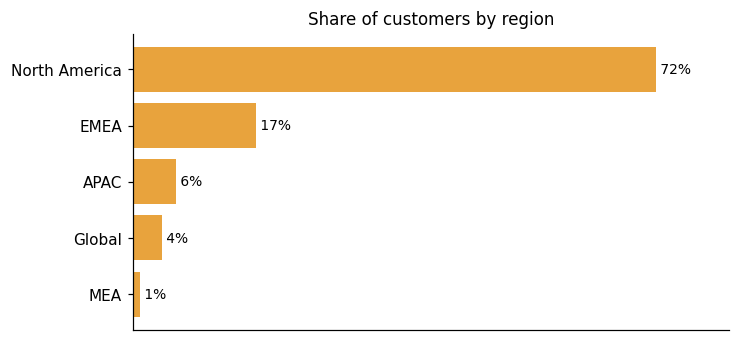
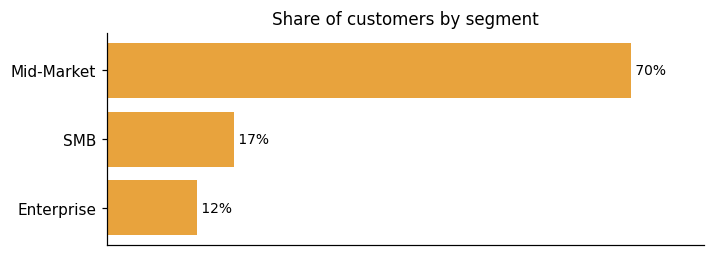
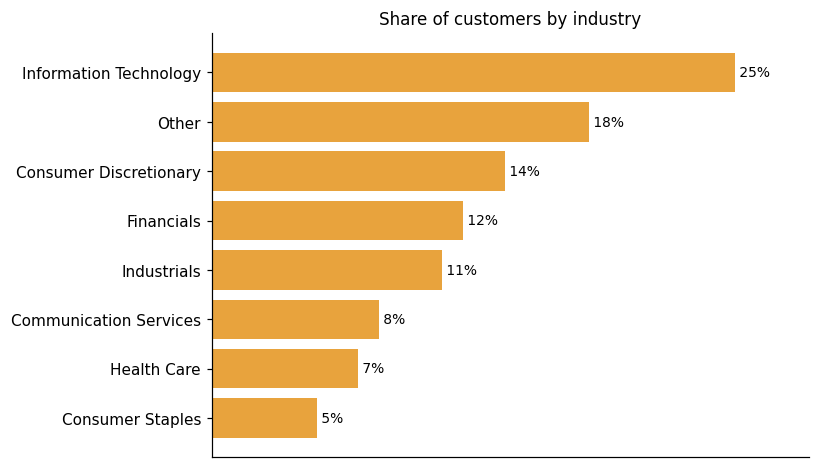
Representative customers: 3Q/DEPT, 9fin, Agero, AllTrails, Article, Articore Group, BARK
How Lattice uses AI in practice
Lattice® applies AI across several specific features while its core people management workflows stand on their own. Performance reviews, engagement surveys, career development, and team habits all function independently of AI. On top of that foundation, AI powers a set of capabilities including feedback summarisation, engagement insight analysis, burnout risk flagging, and personalised growth recommendations throughout the platform. The vendor describes one of these as an always-on HR partner that delivers instant answers, actionable insights, and personalised coaching. That always-on AI Agent is positioned as a persistent presence across the platform rather than a one-off feature.
Generative AI
Read detailsLattice applies generative AI to four specific writing tasks: summarising peer feedback, assisting managers with review drafts, suggesting follow-ups for 1:1s, and recommending growth plan content. The aim is to cut manual writing effort and help managers produce more objective evaluations.
Agentic AI
Read detailsLattice AI Agent handles two distinct jobs: answering questions and surfacing insights for HR teams and managers, and driving personalized development recommendations inside the Grow module. As the vendor puts it, it is an "always-on assistant that proactively surfaces answers, actionable insights, and personalized coaching to HR teams and managers". In the Grow module, the agent works autonomously, drawing on performance data, goals, and feedback to surface development opportunities. Lattice calls this capability Growth Areas.
Predictive ML
Read detailsLattice uses predictive machine learning to spot problems before they become crises — analyzing performance and engagement data to flag burnout risks, identify trends, and surface signals about manager effectiveness. This gives HR teams room to intervene before issues escalate.
Anomaly / Pattern Detection
Read detailsLattice uses AI to turn raw employee survey data into ready-to-act findings, doing automatically what would otherwise take HR teams hours of manual work. It analyses survey responses to detect the key drivers of engagement, and it surfaces sentiment patterns without anyone needing to comb through results by hand. Trends appear in seconds. So do suggested next steps.
Recommendation / Matching
Read detailsLattice connects performance data, goals, and feedback to career progression actions, then surfaces personalized growth plans for each employee directly within the platform.
Lattice pricing and value: plans, costs and ROI
Lattice® publishes per-seat pricing for several tiers and modules — Talent Management and Foundations at $11 per seat per month, add-ons at $4 or $6 per seat per month, and unbundled modules at $8 per month — while enterprise pricing is sales-gated based on seats, complexity, and scale. The value case draws on five ROI results from four different customers, plus two vendor-stated claims backed by an independent analyst firm report. Lattice also provides an interactive ROI estimator so organizations can find out what the software can do for them. On implementation costs, the vendor states that for performance management software there are no additional costs for change management or implementation, and that Lattice offers a wide range of change management support services, like Lattice University and the Lattice Rollout Toolkit. All contracts include dedicated human support from a customer success team covering onboarding, troubleshooting, and maximizing the value of the platform. Pricing follows a tiered subscription model with per-seat rates and annual contracts.
ROI evidence from 4 customers
Time-to-value: what implementations take
- Workday's implementation takes more than 7 months. Using Lattice means no change management or hidden fees, so you can keep supporting your teams with an intuitive experience for reviews, 1:1s, feedback, and goals.
- just one year after implementation, GoCardless has achieved 100% goal setting within Lattice.
- 100% goal setting achieved within Lattice just one year after implementation
- Within one year of implementation, 97 percent of employees had completed reviews in full
- Only five months after implementation, Olo has almost every Lattice feature live
Who it fits: value by company size
Lattice spans small teams up to enterprise organizations, with a minimum annual agreement of $4,000 and enterprise pricing that scales by seats, complexity, and scale. The modular structure lets teams start with what they need and add on later, which means the entry point is accessible even before a company is ready for the full platform. That said, some smaller organizations find the cost harder to justify relative to their headcount and needs — one user notes that cost feels higher for smaller organizations as per their needs and strength. One company's headcount grew 120% over two years and found their processes breaking before they brought Lattice in, which suggests the platform tends to enter the picture once growth has already strained existing systems. Non-profits with grant-tracking requirements have flagged a gap: time tracking does not currently allocate time or costs to projects or grants, which may limit fit for that segment.
Some per-seat prices are published (e.g., "Talent Management | 11 seat/mo", "Foundations | 11 | seat/mo", add-ons at "+ | 4 | seat/mo" and "+ | 6 | seat/mo", unbundled modules at "$8/month"); Enterprise pricing is sales-gated ("Enterprise pricing varies based on seats, complexity, and scale. Contact us for a custom quote!").
Talent Management
11 seat/mo Performance ReviewsRun structured, fair evaluations that surface impact and growth. PromotionsStreamline promotion cycles with clarity and consistency.
Foundations
11 seat/mo
Plans as published by the vendor on Pricing | Lattice.
Lattice enterprise readiness: security, compliance, migration, and support
Lattice® meets enterprise requirements across four areas: security, compliance, migration, and customer support.
Security controls and assurance
Zero Data Retention: We've partnered with OpenAI under an enterprise agreement that guarantees no data is stored or retained. All prompts and responses are processed securely and returned in real time.
Compliance and data protection
Lattice's compliance posture covers data privacy, data residency, and accessibility, with some documented constraints worth noting. On data privacy, Lattice has had a mandatory Data Processing Agreement in place since 2021 — all customers, new and legacy, are covered, and the vendor notes that Terms of Service incorporate the DPA by reference, so new customers need no separate action. Lattice also has compliance initiatives for GDPR and CPRA requirements in place. For data residency, customers can choose between US and EU hosting. The primary EU hosting location is Frankfurt, Germany, with backup data in Dublin, Ireland, running on AWS. One important constraint: EU data hosting is available to new customers only, with no general migration path for existing US-hosted customers. A further nuance is that even when data is stored in the EU, it will be transferred outside the EU for processing by Lattice and its subprocessors. On accessibility, Lattice is partially compliant with WCAG 2.2 standards, with improvements described as in progress.
Migration from competing platforms
Lattice approaches migration as a structured, supported process. Employee records can be synced from existing systems to get teams up and running faster. A dedicated onboarding manager designs a custom configuration for each organization rather than applying a generic setup. Lattice also supports a phased approach that evolves as an organization's strategy matures, helping avoid future change management. For performance management, no additional costs for change management or implementation apply, and Lattice offers change management support services including Lattice University and the Lattice Rollout Toolkit. There is one documented constraint worth noting. EU data hosting is available to new Lattice customers only, and no migration path from the US to the EU data center is generally available for existing customers. Teams already on US-based hosting who need EU residency cannot simply transfer. On the product side, one customer noted that Lattice has made this easy by creating an integrated system for managing goals, easing what can otherwise be a difficult shift to company-wide OKRs.
Customer support experience
Lattice describes its support as fast, with responses measured in minutes rather than days. The vendor earned Stevie awards and topped the G2 charts, and claims a 99% satisfaction rating from onboarded customers. Support reaches customers through phone, email, and chat. The vendor describes its focus as connecting customers with functional support rather than automated replies. Onboarding gets dedicated attention through a Product Adoption Consulting team, which handles personalized rollout before handing off to ongoing support. As the vendor puts it, new customers are introduced to a Product Adoption Consulting team to roll out the software in a personalized manner. The vendor also describes a human-centered approach to implementation and customer service with specialized relationship management. For its Analytics capability, Lattice provides support during implementation that covers system setup, integration with existing HR tools, and ongoing assistance.
Lattice vs. Adrenalin, Cegid, Paycor and other platforms
Lattice covers performance management, people analytics, and employee engagement within the Human Capital Management (HCM) Suite for Large Businesses category — a class of integrated platforms that helps organizations manage HR functions ranging from recruitment and payroll through to learning, performance, and succession planning in one place. On performance, Lattice includes structured review cycles, OKRs, career development through Lattice Grow, and succession-relevant tools. Its engagement capability collects employee feedback, surfaces AI-powered insights, and supports retention through event-driven nudges and recognition via Lattice Habits. Lattice Analytics ties these together, providing data-driven insights on performance, productivity, and engagement. The grounded facts center on those three areas. The broader HCM category also encompasses functions such as payroll, benefits administration, time and attendance, and recruitment — and the available evidence does not document Lattice covering those areas, which is where it trails the full category scope.
Human Capital Management (HCM) Suite for Large Businesses
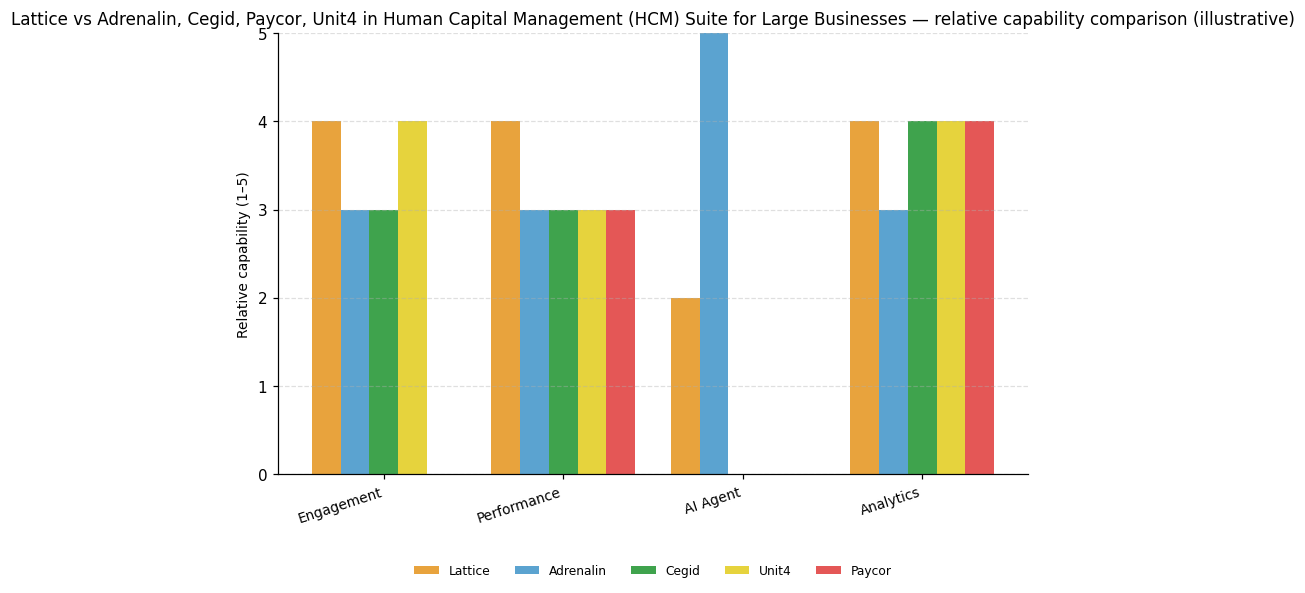
| Capability | Lattice | Adrenalin | Cegid | Paycor | Unit4 |
|---|---|---|---|---|---|
| Engagement | 4 | 3 | 3 | — | 4 |
| Performance | 4 | 3 | 3 | 3 | 3 |
| Analytics | 4 | 3 | 4 | 4 | 4 |
| Updates | — | 4 | 3 | — | — |
| AI Agent | — | 5 | — | — | — |
Lattice®
Engagement: Lattice Engagement collects employee feedback, surfaces AI-powered insights, and supports programs targeting productivity and retention, with event-driven nudges and recognition via Lattice Habits.; Performance: Lattice covers performance management, OKRs, career development pathways via Lattice Grow, succession-relevant tools, and structured review cycles including annual, quarterly, and project-based reviews.; Analytics: Lattice Analytics provides people analytics with data-driven insights on performance, productivity, and engagement, surfacing AI-powered insights from engagement and feedback data.
Adrenalin
Updates: Adrenalin provides AI-driven copilots enabling seamless self-service across mobile, MS Teams, WhatsApp, Slack, and other channels.; AI Agent: Adrenalin provides AI-driven copilots for self-service across mobile, MS Teams, WhatsApp, Slack, and other channels.
Cegid
Analytics: Cegid offers analytics and reporting tools providing deep insights into workforce metrics to support data-driven HR decisions.
Paycor
Analytics: Paycor's COR Leadership Dashboard provides leaders with real-time insights and analytics on employee performance.
Unit4
Engagement: Unit4 HCM is explicitly designed with a strong focus on employee experience, featuring personalized dashboards, mobile accessibility, and social collaboration tools.; Analytics: Unit4 HCM provides analytics and reporting capabilities offering actionable insights into workforce metrics.


Connect Lattice with your stack: integrations and partner ecosystem
Lattice® ships 58 native integrations spanning 49 partner categories. The range covers AI and large language model providers, applicant tracking and recruiting systems, and async video messaging tools.
Lattice spans calendar sync, messaging, project management, and HR system workflows. It connects with dozens of products and systems, including SSO providers, Slack, Teams, Jira, and major HRISs. Dozens of native integrations and Service Partners keep those connections running across the tools teams already use. Calendar sync works in both directions. The Google Calendar integration updates 1:1 events within Lattice in real time, typically within about an hour. The Outlook Calendar integration does the same, with updates arriving typically within about 5 minutes. For its Goals & OKRs capability, Lattice integrates with Slack, Teams, and project management tools like Jira, keeping goal progress visible inside the workflows where teams are already working.
| Partner category | Integration partners | Native count | Flow direction |
|---|---|---|---|
| AI / large language model provider | OpenAI | 0 | Upstream |
| Applicant Tracking System (ATS) / Recruiting Software | Lever | 1 | Unknown |
| Async Video Messaging | Loom | 1 | Unknown |
| B2B Intent Data / Sales Intelligence | Bombora | 1 | Unknown |
| Business Data & Analytics / Credit Intelligence | Dun & Bradstreet | 1 | Unknown |
| CRM | Salesforce | 1 | Upstream |
| Compliance Automation | anecdotes | 1 | Unknown |
| Corporate Cards & Expense Management | Volopay | 1 | Unknown |
| Corporate Cards & Spend Management | Ramp | 1 | Unknown |
| Customer Messaging / Support Platform | Intercom | 1 | Unknown |
| Employee Benefits & Perks Platform | Perkbox | 1 | Unknown |
| Financial Planning & Analysis (FP&A) Software | Drivetrain, Mosaic | 2 | Unknown |
| Furniture / Home Goods E-Commerce | Article | 1 | Unknown |
| Global Employment / Employer of Record (EOR) | Oyster® | 1 | Unknown |
| HR / Payroll & Benefits (PEO) | Justworks, Inc. | 1 | Unknown |
| HR Analytics / People Data Dashboard | Employee Cycle | 1 | Unknown |
| HR Consulting | livingHR | 1 | Unknown |
| HR Management Software | Omni HR | 1 | Unknown |
| HR Onboarding & People Operations Software | Sapling | 1 | Unknown |
| HRIS | BambooHR, HiBob, Humaans | 3 | Upstream |
| HRIS / ERP / human capital management | Workday | 1 | Upstream |
| HRIS / HR and IT management platform | Rippling | 1 | Upstream |
| HRIS / PEO | TriNet | 1 | Upstream |
| HRIS / human capital management | UKG | 1 | Upstream |
| HRIS / payroll | ADP, Gusto, Namely, Personio, Zenefits | 5 | Upstream |
| Identity & Access Management (IAM) | Microsoft Entra ID | 1 | Unknown |
| Interview Scheduling / Recruiting Automation | GoodTime.io | 1 | Unknown |
| Learning & Development / Upskilling Platform | EvolveUp | 1 | Unknown |
| Marketing Automation | Marketo | 1 | Unknown |
| No-Code Website Builder / CMS | Webflow | 1 | Unknown |
| Online Technical Education / Nanodegree Programs | Udacity | 1 | Unknown |
| Outdoor Recreation / Trail Navigation App | AllTrails | 1 | Unknown |
| Payroll & HR Software | Paycom Software | 1 | Unknown |
| Project Management / Work Management | Asana | 1 | Unknown |
| Recruiting Intelligence / Reference Checking | Crosschq | 1 | Unknown |
| Retail Investment / Stock Trading Platform | RobinHood | 1 | Unknown |
| Revenue Operations Consulting | Go Nimbly | 1 | Unknown |
| SaaS Management / Software Spend Intelligence | Productiv | 1 | Unknown |
| Security Compliance Management | Strike Graph | 1 | Unknown |
| Sustainable / Compostable Packaging Products | Repurpose | 1 | Unknown |
| Team Communication / Community Messaging | Discord | 1 | Unknown |
| Tech Job Marketplace / Recruiting Platform | Underdog.io | 1 | Unknown |
| Unknown | Unfurl | 1 | Unknown |
| Workforce Analytics / Employee Monitoring | ActivTrak.com | 1 | Unknown |
| cloud platform / identity and access management | Microsoft Azure | 1 | Upstream |
| identity and access management / SSO | JumpCloud, Okta, OneLogin | 3 | Upstream |
| productivity / collaboration suite | Google Workspace | 1 | Bidirectional |
| project management / issue tracking | Jira | 1 | Upstream |
| team collaboration / communication | Microsoft Teams, Slack | 2 | Downstream |


Lattice News
Lattice Launches Mach-N2 FPGAs With Post-Quantum Security
Lattice Semiconductor launched the Mach-N2 FPGA family, featuring post-quantum security and built on the Nexus 2 platform. These devices offer enhanced logic density, integrated flash, and advanced security features like crypto agility and anti-tamper monitoring. Lattice also introduced Lattice Prompt, an AI-assisted FPGA development tool compatible with various coding environments, reinforcing its secure-control strategy.
Lattice Advances FPGA Design with New Leadership AI-Driven Development Tool, Lattice Prompt
Lattice Semiconductor has launched Lattice Prompt, an AI-driven FPGA development tool designed to enhance productivity and optimize performance for small and mid-range FPGAs. The tool integrates with various IDEs and large language models, providing natural language access to the full FPGA design flow, including simulation, synthesis, and timing analysis. Lattice Prompt is available as a free download and works with the latest Lattice Radiant design software.
Anduril Pitches Lattice For Port Defense, Demonstrates Sea Integration At BlueTide
Anduril Industries integrated its Lattice software with a Voltaic Marine unmanned surface vessel during the BlueTide 2026 event, showcasing its capabilities for port defense and other homeland security applications.
Lattice Profile
HQ Location
22 Battery St. - 11th Floor San Francisco, CA 94111
Employees
11-50
Social


Financials
SERIES F